
The ROI of Through-Partner Marketing
With an uncertain economy, there’s an extra sharp lens on budgets of all kinds, and high on the list of evaluation criteria is ROI.
The two main line items for Channel leaders are their people budgets (Channel sales, Partner Account/Business Managers, Channel Operations, and Channel Marketing), and their program dollars. Program budgets include things like training & certification programs, channel incentives, market development funds (MDF), and channel marketing programs. So how does a leader determine where to invest? It all comes down to return.
Through-Partner Marketing (TPM) “represents the third stage for channel sales and marketing leaders”(source: Forrester), following the automation of CRM and marketing processes. It’s growing fast, and yet many companies are still testing the waters. With the advances in automation, TPM brings about a welcome improvement in the ability to measure the effectiveness and return of MDF and marketing programs and investments.
How to measure MDF return
If you have been in channel partner marketing as long as we have, you’ll know that it’s especially hard to measure and report on MDF returns. For many vendors, measurement is loose at best, and they often throw up their hands, claiming MDF is a “cost of doing business” with partners, rather than a strategic growth lever. We have even heard stories of vendors threatening to cut off MDF if partners didn’t provide real metrics, only to pay out the MDF the next quarter because, well, what other choice did they have?
Through-partner marketing can connect the dots and provide real metrics. But first…

What is Through-Partner Marketing?
Through-partner marketing enables brands to extend and amplify their marketing, connect with and enable more partners, reach more customers, control the digital customer journey, and drive revenue for every player in their channel ecosystem. It is a strategic marketing lever for the 89% of companies that use partner sales. It enables partner growth and creates partner loyalty.
From the partner’s perspective, TPM is an enabler. It is an investment from their vendor in their own go-to-market and digital maturity. It elevates their presence and credibility so they can be found in the customer’s digital journey. It helps to expand the breadth of partner offerings, drives leads, and builds deeper loyalty with vendors.
Measuring Through-Partner Marketing ROI
Basic PMA tool analytics can tell a manufacturer or a distributor which marketing messages and activities are resonating best and driving real engagement with potential customers. For example, we tell our clients how many views they had of their own content across their partner ecosystem, which content was the most popular, which posts had the most engagement, and which documents were downloaded most often. We know the open and click-through rates of Ads and emails that are sent through partners, who opened and clicked through, and how many leads were generated. And, we can look at it across campaigns, or by partner. Vendors can review, optimize and invest in MDF activities and partners that are driving the most engagement.
But at a deeper level, we calculate return on investment of the solution, and there are 2 categories of attribution – directly attributable revenue, and indirectly attributable revenue. Here’s how we do it.
Directly Attributable Through-Partner Marketing Revenue
This is the most intuitive. As customers click through on social posts, emails and paid ads, view content, and convert online, leads are generated, partners follow-up, and deals are closed. We track deals in a partner portal, and vendors can calculate ROI. If your business is transactional, customers can convert directly on a centrally-managed store for even tighter reporting.
Indirectly Attributable Through-Partner Marketing Revenue
This one is less intuitive and a little harder to measure, but that doesn’t make it any less valuable. In fact, one could argue it’s just as valuable (if not more). Through-partner marketing not only gets vendor content in front of more customers, but it also enables your partners to immediately participate in the customer digital journey. Their digital presence is elevated such that they are “found” by customers who are actively looking for your/their solution, and that should not be underestimated.

McKinsey & Company reports that “100% of B2B customers prefer omnichannel, no matter the industry, country, size, or customer relationship stage. There are no exceptions.” Omnichannel means that digital is key – 82% of B2B buyers utilize search to interact with a company before making a purchase, and 84% of B2B executives use social media as a source for making those purchase decisions. Partners need to participate in the digital journey.
They need to be where those buyers are searching and researching, but most of them need your help to get there. Small and medium-sized partners (aka “long tail” partners) are tight on resources. Studies indicate that 84% of them don’t have in-house resources and struggle to transform to new ways of marketing, even with MDF incentives.
TPM does exactly that and partners will reward vendors for it.
In our experience working with vendors and partners in TPM engagements, 75% of partners reported that they believed the vendor with whom they had TPM benefits “invested in the success of their business.” Additionally, when growth rates were calculated by vendors, the partners who participated in the TPM program had significantly higher growth rates than those who did not.
Partner loyalty and “stickiness”, while somewhat more difficult to measure, are even harder to develop, but worth their weight in gold.
In addition, the joint brand marketing – between you and your partners – is an immediate lift for both your and your partners’ brands and credibility. Think of it as two-way advocacy across hundreds, or even thousands of partners, and in front of millions of customers.
The exponential brand awareness should not be dismissed.
Boston Consulting Group (BCG) explains that while “Companies often debate the value of B2B brand marketing, underestimating the value of brand marketing is a mistake.” BCG’s research shows that companies that are “more mature in terms of brand marketing generate higher ROMI [return on marketing investments]; and moreover, strong brand marketing capabilities actually reinforce performance marketing, leading to better engagement overall.”

And those who invest are seeing real results. BCG reports that “B2B companies that have reached the amplifying level of maturity perform far better, generating returns on their brand marketing investments that were 46 percentage points higher than those at the nascent level.”
This research is consistent with our experience. More customers see your brand, and your partners reward you for it with loyalty, and, wait for it – more business revenue.
So exactly how much is the return?
Let’s take an example.
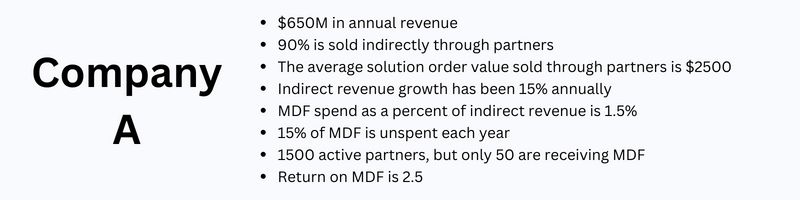
Company A wants to launch a Through-Partner Marketing solution for a subset of their long-tail partners. The recommendation for Google Ads for the Channel would be to start with a smaller subset of the partner participants and increase over time.
The Numbers
The Cost
The cost depends on the complexity of the services that Company A chooses and the number of partners in the program, but they can expect to pay between $20-120 per partner per month for a Managed TPM solution. (The more partners, the lower the per-partner cost) Additionally, they would re-direct a portion of their existing paid Ads media budget to their partners and pay a platform & agency fee commensurate with the amount of media they choose.
The Return
Depending on how many partners Company A includes in their TCM program, ROI can be 20 – 30x.
- Using industry averages for email opens, clicks and conversions, if Company A starts with 100 partners, they should see a return of approximately $1.5M on the directly attributable revenue. With 500 partners, we expect Company A to reap $3.4M through its partners.

For the indirectly attributable revenue, we calculate the amount of growth that the long-tail partners represent and apply what we have experienced with our clients. The increase comes from the brand marketing, the partners being “found” online through web content, social media, and more active communication with their customers. Company A’s content on the partner sites boost engagement and overall credibility, and the relationship with between Company A and their participating partners is stronger. When you add the Google Ads, the boost is higher.
- We calculate the indirectly attributable revenue return to be $1.9M for 100 partners, and $9.7M for 500 partners.
- Total expected return is $3.4 – $13.1M.
The ROI will build over time. Company A and their partners will experience benefits immediately, but the ROI will grow as the TCM program continues to work. For example, one company saw a 75% improvement in their cost per click with Google Ads over a 2-year period.
How to fund a new TPM initiative when budgets are shrinking
Company A has 15% of their MDF unspent each year. This represents $1.3M in MDF that is not producing the 2.5x expected return of $3.3M. We recommend re-allocating a fraction of this to support Company A’s long-tail partners with a Through-Partner Marketing initiative that will drive new revenue, new brand awareness, and a fresh new direction for Company A and its partners.
The return of $3.4 – $13.1M far exceeds $3.3M of lost return from the unspent MDF – even at the lower partner participation rate. AND since the Through-Partner Marketing costs a mere fraction of the unspent MDF, there’s still room for Company A to reduce overall spend, if required.
If you happen to be a distributor, then you’ve got a whole other opportunity to fund your TPM initiative, namely from your own suppliers who also want to get their products and services in front of your partners’ customers. Your vendor suppliers have their own MDF that can flow to you for the new digital marketing opportunity.
Calculating the value for partners
There’s a strong business case for partners to want to participate. If each partner had to pay for the digital marketing services themselves, it may very likely be much more than they could afford to do on their own – if they even had the resources.

Instead, partners have the unique opportunity to participate in a TPM program and leverage that $60k investment that their vendor or distributor is making on their behalf, learn the digital ropes, and grow their businesses.
Through-Partner Marketing Managed Services
There are many benefits to a Managed Through-Partner Marketing services model. You can read more about that here. But in the context of ROI, accessing TPM as a service delivers more. One key reason that companies don’t realize the return when they launch TCM themselves, is the lack of access and expertise across a multitude of required resources, namely:
- Marketing program manager
- Marketing communications
- Partner lead
- Platform SMEs
- Social media manager
- Graphic designer
- Digital ads program manager
- Copywriter
- Business analyst

Accessing a service that includes all of those resources is a less expensive option, and with an efficiency factor that improves overall service delivery, drives a faster time to market, improved overall performance, and a better ROI.
Why you should invest in TPM now
Three reasons.
- Budgets are under scrutiny and leaders are demanding better returns on spend. You can reduce your MDF (at least by the amount of unspent funding), spend LESS on automated Through-Partner Marketing services, and generate new revenue.
- The path to purchase is through your partners, and you need them all online. If they’re not online, neither are you.
- Your partners need help, and if you don’t help them, another vendor will.
Calculate your own ROI
If you want to explore TPM for your company, you can use this online calculator to see what your own ROI could be.