
Vendor/Partner SEO is Driving the Customer Journey
Earlier this week we posted a question on LinkedIn… “What if your partners could rank at the TOP of Google search for YOUR solutions?”
But what does that mean for a Vendor, and why should you care how your partners rank on Google?
It means this:
- That buyers will find YOUR solution when they search and
- They will find it from a partner you trust who is promoting your product/solution, and
- That the partner is local and relevant to the customer in their buyer’s journey
All of these make it much more likely that the buyer will end up with your solution from your best partners.
Buyers are online, and they’re searching for solutions – whether it’s cybersecurity services, solar panels, or hand sanitizer. In fact, 71% of B2B buyers begin their research with generic Google searches and 90% of B2B researchers who are online use search specifically to research business purchases. A customer who finds your solution from the right partner could be like finding a needle in a haystack if you leave it to chance.
Partner Marketing & Driving the Buyers Journey
If buyers are starting online, then you should start there, too. When you start with search, there are two main types of results:
- Organic search results (unpaid)
- Paid search results
In this blog, we’ll talk about the first – organic search results. (We have already covered the second one in a previous blog, “You’re losing buyers via paid search every day” which you can find here.)
What are Organic Search results?
Organic search results are the listings that show up on Google, Bing, or other search engines, “naturally.” Google determines the most relevant results for a search query and returns those at the top of the search results list, just below the paid ads. This is extremely valuable real estate since 92%of web search traffic comes from Google’s Page One.
How do you be the most relevant?

This is the science part, and it’s called Search Engine Optimization, or SEO. It’s a key component of digital marketing and is the process of improving/optimizing a website to increase its visibility to Google, and to signal to Google that the website is the most authoritative, relevant website for the search query. Think of it as “marketing to Google” instead of marketing to a customer.
What does Google use to determine that a website is authoritative and relevant? Without going into a lot of technical detail, here are a few important factors at a high level:
- Google looks to see if the keywords being searched are found on the website.
- Google will also look at the type of content, and how long people spend on the site (if they always bounce after a few seconds, Google figures it’s not relevant).
- Google wants to see content that’s fresh/new/current.
- The website must be technically cohesive so that Google can crawl through it to find the content.
- The website must also load easily. Google doesn’t want to send a searcher to a site that is slow or doesn’t look good on a mobile device.
- Google also looks to see if other websites reference it. The more links others have to a website, the more authoritative it’s deemed by Google.
- Google looks for location when determining relevancy.

SEO and your buyer’s journey
Ok, back to your partners. Have you ever mapped out a buyer’s journey? When a buyer is searching for your solution, what are they typing in the Google search bar? What then comes up in the search results, and most importantly – does it take the buyer to a place where they can purchase your solution? If you sell through partners, is the buyer directed to your solution from the right partner? Probably not.
Most partners are small/medium businesses. In fact, 90% of them are SMB, (this is a technology channel stat, and our experience tells us it’s pretty much the same across industries) and about 85% don’t have internal marketing resources to either work on SEO or hire an agency to do it for them. So, your partners need your help. And frankly, it only makes sense that you work together since partners are driving so much of your revenue.
How is AscendX Digital doing Vendor/Partner SEO?
This is a story of how we are working with a Vendor who has many partners across the world, and how we are working with a number of their partners here in the US & Canada to drive the customer journey.
The Vendor sells their products through resellers – some very large, and most SMBs, and they know that local businesses are buying from local resellers. Optimizing search results for their keywords (words buyers are typing into the search bar on Google) and directing buyers to their own Vendor site is ok for general brand awareness, but it doesn’t help with the buyer’s journey. So instead, the Vendor has identified key partners in key locations in whom they want to invest.
At a high level, here’s the process:
- Vendor identifies the key products and solutions and how buyers may be searching. These become the proposed keywords.
- We meet with the partner to talk about how they sell those products, in what context, and if they are part of a larger solution that customers are looking for. We ask them what customers in their location are asking them for. This refines the keywords.
- We do research. We look at the partner site and identify what the partner may be ranking for, and how they are positioned for the refined Vendor keywords.
- We also look at the partner’s local competition to understand who may be beating the partner in search, and where there are opportunities to leap-frog and win the top spots.
From there, we build a roadmap. We look at:
- Low-hanging fruit – These are search terms that have high volume (LOTS of people are using these terms to search) and low competition, which are opportunities to improve ranking more quickly and drive significant organic traffic
- Striking distance – These are search terms that the partner is already doing fairly well (perhaps page 2 or 3 on Google) where we can make gains.
- Long-Tail – These are more specific search terms (think “red delicious apple” vs. “apple”) that are targeting more relevant, specific searches.
- Outperform the competition – These are keywords where the partner may be on page one, and we need to defend that position.
And then we go to work.

- Technical SEO – Remember when we said Google needs to be able to craw the site and find what it’s looking for? This is that. We work on the back end of the partner site to ensure Google can find what it’s looking for.
- Onsite SEO – This is the part about finding keywords and key information throughout the partner site. The Vendor’s product information, key phrases, and content need to be on the partner site in a way that’s relevant and meaningful.
- Content – We help the partner add significant Vendor-focused content onto their site – whether it’s a solution page or a detailed blog, there must be an anchor of great content.
- Offsite SEO – Remember when we said that Google is looking for authority, and looking for other external websites linking to information on the partner site? We do that here. Actions such as social mentions, guest blogging, building offsite informational content, commenting, and other activities all drive links that help the partner site to build its credibility in the eyes of Google. And – all of it is co-branded Vendor product/solution focused to drive the right results.
So what are the results?
First of all, it’s important to state that SEO is a long game, and one that doesn’t really end. Even if a site is updated from a technical point of view, and content is added, Google is always looking for new, fresh content to keep a site at the top of the search ranking. And, competitors are trying to leapfrog your partners, too. So constantly monitoring, adjusting, linking, and refreshing content is critical.
Additionally, SEO takes time. You may do the work above, but Google isn’t going to rocket the site to the top right away. It generally takes 3+ months to see solid results. It’s different for everyone since industries, population/density, and competition are different everywhere. But – we do sometimes see some fast improvements.
Here are a couple of recent results from two partners in two different US cities – one that is 60 days in, and another 30 days into their Vendor/Partner SEO:
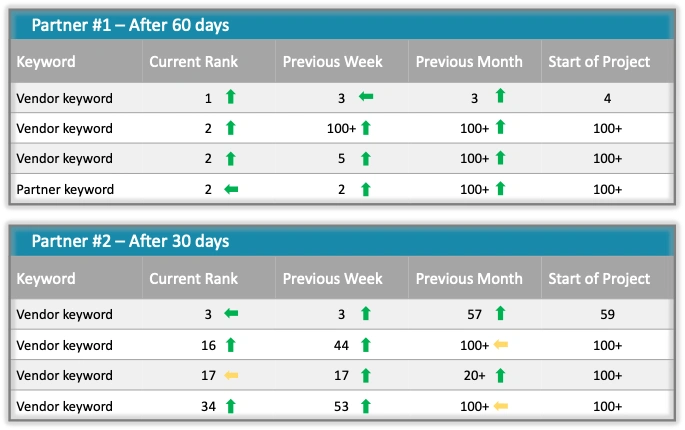
In a nutshell, what you see is that for the refined Vendor keywords and content that we chose to influence, these partners are moving up the Google ranking – and that means that the buyers are being directed to the partners where the Vendor is making their investments.
There are other metrics, like organic website traffic for which we are also seeing increases.
How the Vendor is facilitating this with partners
The Vendor has a marketplace of digital partner marketing services, and the partners “shop” in this marketplace with their Market Development Funds (MDF). Some partners are starting with Vendor/Partner SEO, others with Paid Search Ads, and others with Email marketing and Social selling. It’s an easy way for partners to engage, use their MDF funds, and improve their overall digital presence.
Additionally, because the marketplace carries Vendor-approved services, the administrative burden of approving and claiming almost disappears. It’s an improved experience for both the Vendor and the partner.
We are driving the customer journey
We are meeting buyers when they are searching and directing them to the Vendor product information with the Vendor’s chosen partners. No more leaving it to chance and losing buyers in the process.
If you’re a Vendor, Manufacturer, or Distributor who works with partners and want to elevate your partner marketing and take control of your customer’s digital journey, contact us. We would be happy to walk you through how this can work for you.